TransformStamped
header.frame_id is the parent frame; transform maps child_frame_id into it.
Preview
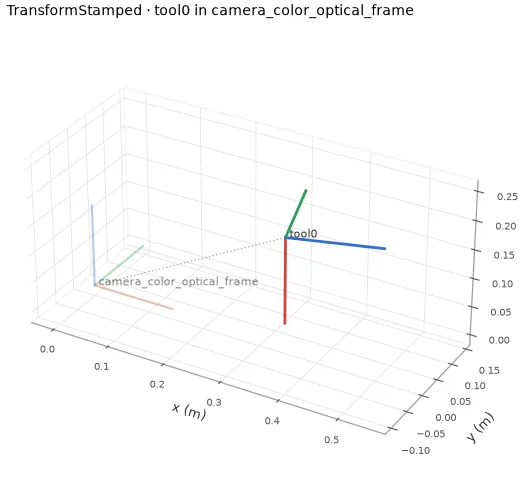
The figure robot_msgs.viz.plot(example) draws for the example below.
Fields
| Name | Type | Default |
|---|---|---|
header | Header | Header() |
child_frame_id | str | '' |
transform | Transform | Transform() |
Example
One instance from the package's own test catalog; the output is its real repr().
TransformStamped(header=Header(stamp=1761600000.25, frame_id='camera_color_optical_frame'), child_frame_id='tool0', transform=Transform(translation=Vector3(x=0.4, y=-0.1, z=0.25), rotation=Quaternion(x=-0.10566871683993562, y=0.6991667342497077, z=0.10566871683993563, w=0.6991667342497078)))to_dict() as JSON
{
  "_type": "geometry/TransformStamped",
  "header": {
    "_type": "std/Header",
    "stamp": 1761600000.25,
    "frame_id": "camera_color_optical_frame",
    "meta": {}
  },
  "child_frame_id": "tool0",
  "transform": {
    "_type": "geometry/Transform",
    "translation": {
      "_type": "geometry/Vector3",
      "x": 0.4,
      "y": -0.1,
      "z": 0.25
    },
    "rotation": {
      "_type": "geometry/Quaternion",
      "x": -0.10566871683993562,
      "y": 0.6991667342497077,
      "z": 0.10566871683993563,
      "w": 0.6991667342497078
    }
  }
}
Long arrays are cut after 16 values and say so with “…”.
Functions
Constructors
Classmethods and staticmethods: ways to build one.