Plane
coef = (a, b, c, d): the points with a·x + b·y + c·z + d = 0, in the frame the owner names. (a, b, c) is the normal and need not be a unit vector, as in ROS.
Preview
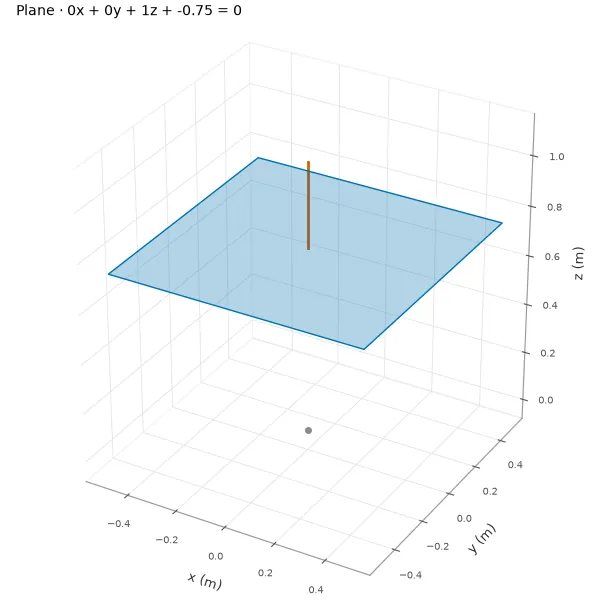
The figure robot_msgs.viz.plot(example) draws for the example below.
Fields
| Name | Type | Default |
|---|---|---|
coef | Array | required |
Example
One instance from the package's own test catalog; the output is its real repr().
Plane(coef=[ 0. , 0. , 1. , -0.75])to_dict() as JSON
{
  "_type": "shape/Plane",
  "coef": {
    "dtype": "<f8",
    "shape": [4],
    "data": [0.0, 0.0, 1.0, -0.75]
  }
}
Long arrays are cut after 16 values and say so with “…”.
Functions
Constructors
Classmethods and staticmethods: ways to build one.
from_point_normal(point: Any, normal: Any) -> PlaneThe plane through point with the given normal (any length); coef comes out with a
Properties
Read-only views computed from the fields.
Related types
No other type refers to it, and it refers to none.